
How Olive Oil Is Made: The Complete Production Process Explained

Olive Knowledge is a part of Amazon Associates. As an Amazon Associate, we earn from qualifying purchases. Read our Affiliate Disclosure to learn more.
If you’ve ever wondered how olive oil is made, from the moment olives are picked off the tree to the final bottled product on your shelf — you’re in the right place.
I’ve been through the whole olive oil production process multiple times, and decided to share with you a full breakdown of how it works.
There are different ways to harvest olives, different methods of extraction, and many details that determine whether you end up with a high-quality extra virgin olive oil or a lower grade. I’ll explain it all in a simple way so you can understand everything, even if you’re a complete beginner in the world of olives and olive oil.
Quick Answer:
- Olive oil production begins with harvesting olives at their green-ripe stage.
- Post-harvest, olives are quickly transported to mills to avoid oxidation.
- At the mill, olives are crushed into paste using modern crushers.
- Oil extraction from the paste occurs via horizontal centrifugation.
- Post-extraction, olive oil undergoes filtration to remove impurities.
- Finally, the oil is graded, tested, and bottled, remaining fresh for up to two years unopened.
What Is Olive Oil Made Of?
Before diving into the production process, let’s cover the basics. Olive oil is made from one single ingredient — the fruit of the olive tree (Olea europaea). Unlike many seed oils that require chemical solvents for extraction, olive oil is essentially just fresh olive juice extracted through mechanical means.
The olive fruit consists of about 20-25% oil, depending on the variety and ripeness. The rest is water, pulp, and pit. Not all olives are used for oil production — some varieties are better suited as table olives, while others are specifically cultivated for their high oil content.
The key compounds that make olive oil special are its monounsaturated fatty acids (mainly oleic acid), polyphenols, tocopherols (vitamin E), and other antioxidants. The production method directly affects how many of these beneficial compounds end up in your bottle.
Now, let’s go through the process step by step.
1. Harvesting the Olives
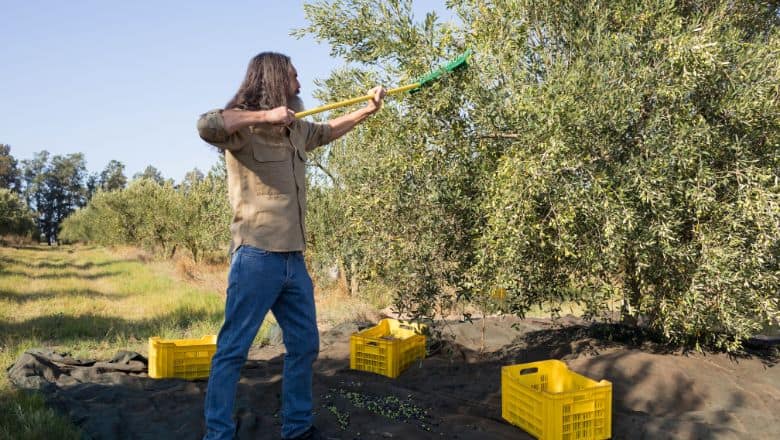
The process of olive oil production starts with harvesting the olives at their green-ripe stage when their juices turn cloudy.
Related: Is Picking Olives Hard?
Harvesting is usually from April to August in the Southern hemisphere and October to January in the Northern hemisphere. It starts with picking green olives and continues as the olives ripen to a dark color.
The quality of oil produced differs based on the color of the olives picked. Green olives produce light and slightly spicy oil with a fresh green aroma. As the olives get darker, the oil becomes fruitier and darkens slightly in color.
Olives oil is generally produced through a mechanized process. The two processes of olive harvesting widely used in most olive farms are mechanical vibration and the Vareo method.
Vareo olive harvesting involves the use of wooden rakes that are used to hit the olive fruits off the tree. These fruits fall onto harvesting nets underneath that protect them from falling to the ground.
Vareo harvesting gets the olives off the trees quickly but damages some of the ripe fruits and parts of the olive trees.
Therefore, most farmers harvest their olives using mechanized processes that vibrate them off the trees. This is done using tractors or mechanical tree shakers.
Once harvesting is complete, the olives are taken to the mill for further processing.
2. Transporting the Olives to The Mill
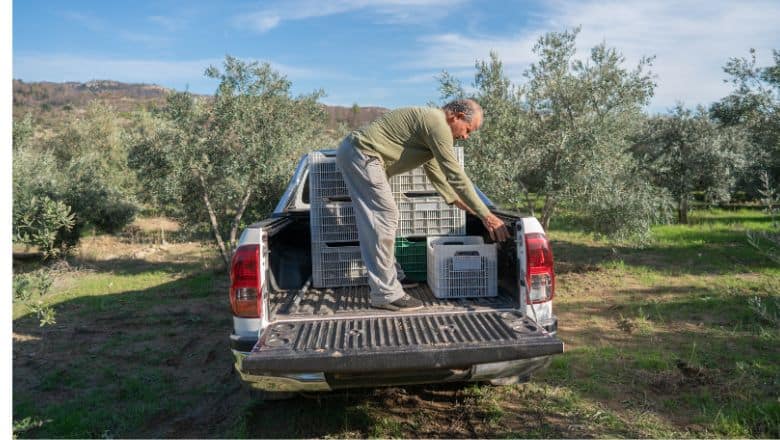
It is recommended that the olives are crushed within 24 hours of harvesting to avoid oxidation or fermentation. This guarantees the freshness of the olive oil produced and ensures its high quality.
Harvested olives must be transported to the mill in open cases to ensure the olive oil produced is as fresh as possible. This is referred to as same-day milling.
The olives are sorted, graded, washed, and weighed at the mill before being transported to the hoppers for crushing.
Related: How Much Olive Oil Can an Olive Tree Produce
This is one of the most common questions about olive oil production. During early harvest, approximately 8 kgs of olives are required to make a single liter of olive oil. However, once the olives ripen, only 4-5 kgs of olives are needed to produce a liter of olive oil.
That means it takes roughly 5,000 to 8,000 individual olives to produce just one liter. The exact number depends on the olive variety, the ripeness at harvest, the climate that season, and the extraction method used. This is one reason why olive oil is so expensive compared to other cooking oils.
3. Crushing and Pressing: Turning Olives into Paste
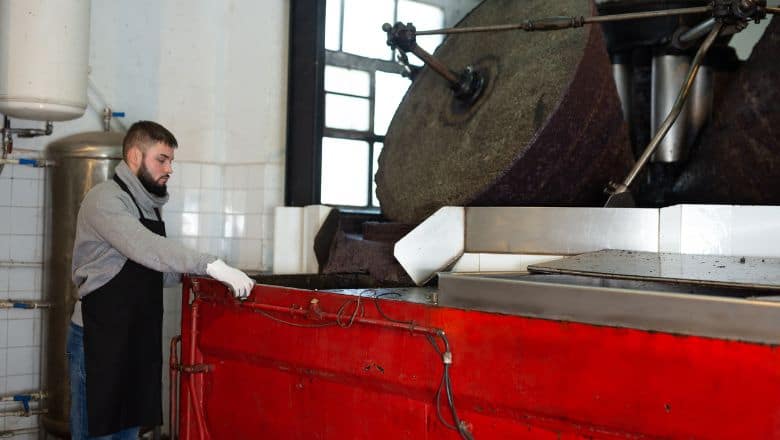
Crushing breaks down the flesh and seeds of the olive fruit into a paste to facilitate easy extraction of olive oil. Although stone mills are traditionally used to crush olives for oil extraction, metallic olive crushers are better.
These modern olive crushers are classified into disk, blade, or hammer crushers. The olive oil extracted using hammer crushers has more phenolic and α-tocopherol compounds. It also has a stronger pigment due to intense chlorophyll extraction.
Therefore most olive oil producers use metallic crushers for oil extraction.
During crushing, the washed olives are mashed into a paste and then transferred to a malaxer. This is where the homogenous olive paste is slowly stirred to allow tiny oil droplets to merge into larger ones, making the oil easier to separate from the pulp. Malaxation is a critical step — the temperature and duration directly affect the oil’s flavor, aroma, and polyphenol content.
4. Olive Oil Extraction Through Centrifugation
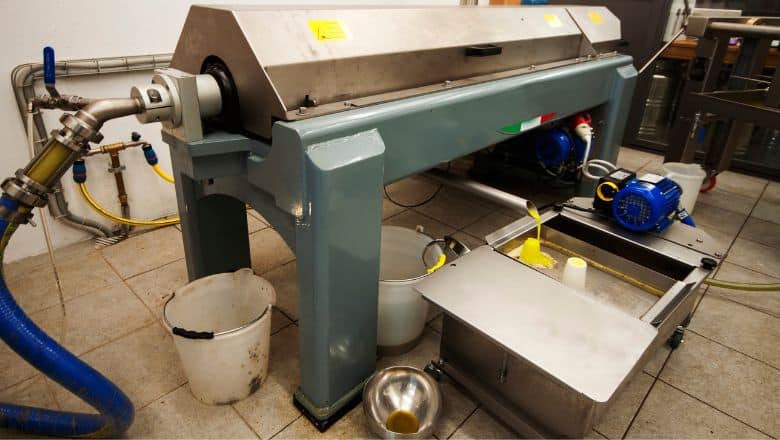
Olive oil extraction should occur within an hour of crushing and malaxing. The ideal temperature for olive oil extraction is below 27 °C (80.6 °F). This is what makes it “cold pressed” — the oil is extracted without using heat, which preserves its natural compounds and flavor.
The extraction of the olive oil from the crushed and whipped olives occurs via horizontal centrifugation. This process requires less effort and produces high-quality olive oil that’s low in acidity.
Centrifugation involves the extraction of olive oil through a spinning motion. This separates the solid components of crushed olives called Pomace from Alpechin (the vegetable wastewater) and olive oil. Modern mills typically use either a 2-phase or 3-phase decanter centrifuge. The 3-phase system adds water to help separate the oil, while the 2-phase system doesn’t — producing oil with a slightly higher polyphenol content.
At the end of the centrifugation process, which takes 30-40 minutes, the olive oil is finally separated from the Pomace, Alpechin, and water.
5. Filtration and Grading: Ensuring Olive Oil Quality
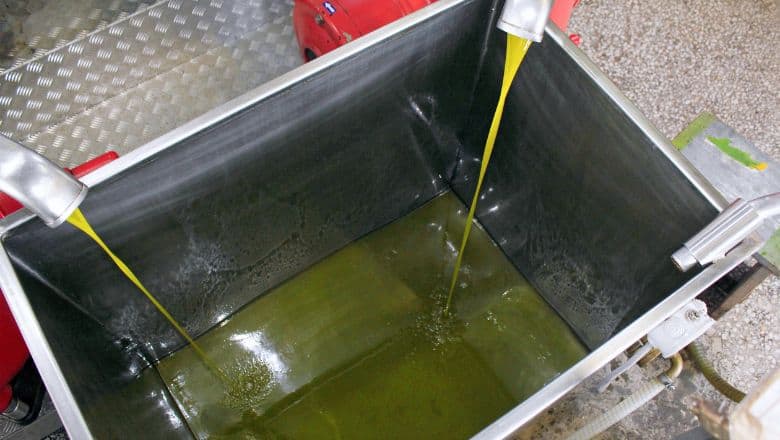
Once the centrifugation process is complete, the olive oil is set aside for filtration or decanting. This involves using gravity to separate any remaining impurities or solid materials from the pressed oil.
Related: Filtered vs. Unfiltered Olive Oil: Comparison
Quality control experts then evaluate and grade the freshly pressed olive oil based on organoleptic content and acidity levels. This is usually done through sensory analysis, where the oil is graded according to international standards set by the International Olive Council (IOC).
The categories under which virgin olive oil is graded are Lampante Virgin, Virgin, and Extra Virgin Olive oil. The latter is the best type of olive oil because it contains the highest amounts of polyphenols and has the lowest acidity (below 0.8%). To learn more about what separates high-quality olive oil from the rest, check out our guide on how to recognize high-quality olive oil.
The benefits of extra virgin olive oil are well-documented — its high polyphenol content is linked to reduced inflammation, better heart health, and antioxidant protection.
The graded olive oil is then stored in stainless steel tanks away from oxygen and light at 18 degrees Celsius. Keeping the fresh olive oil in this way preserves it from degradation until it is ready for bottling.
6. Bottling and Packaging: The Final Stage
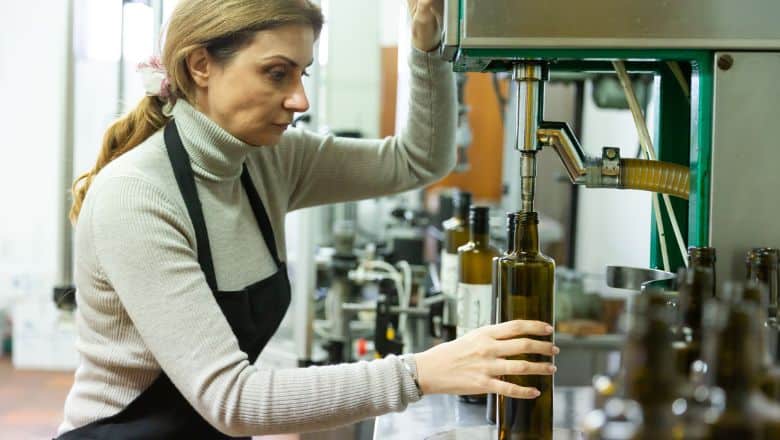
Graded olive oil is usually resampled and tested before bottling to ensure no oxidation has occurred. It is then packaged into different containers depending on the quality. This results in Extra virgin olive oil (EVOO), Virgin olive oil, and Regular olive oil.
Bottling and packaging of olive oil are done using gravity and vacuum bottle fillers in integrated oil bottling lines. The best types of containers for packaging olive oil are opaque glass bottles. They protect the olive oil from UV and heat damage, extending its shelf life.
Such well-processed and bottled olive oil can remain fresh for up to 2 years when unopened. Once you open it, the clock starts ticking — check out our tips on how to store olive oil after opening to get the most out of your bottle.
Where Is Olive Oil Made? Top Producing Countries
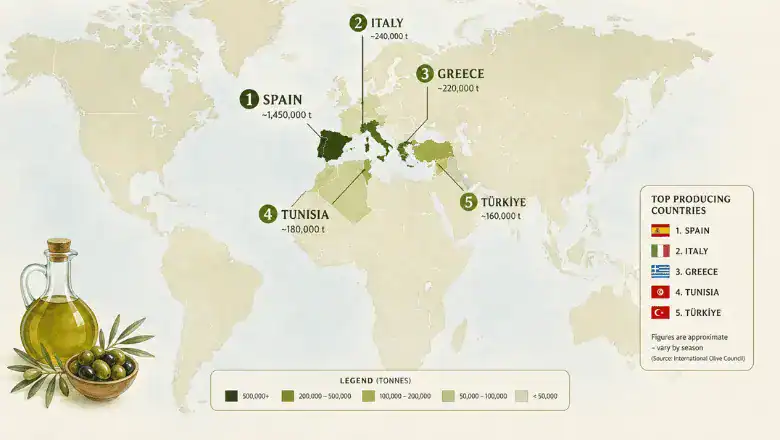
Olive oil production is concentrated in the Mediterranean basin, which accounts for roughly 95% of the world’s supply. The top olive oil producing countries are:
- Spain — the world’s largest producer, responsible for nearly half of global production. The Andalusia region alone produces more olive oil than most countries.
- Italy — known for its diverse regional oils, from Tuscan to Sicilian varieties.
- Greece — one of the highest per-capita consumers of olive oil in the world.
- Tunisia — the largest producer in Africa and a growing export powerhouse.
- Turkey and Morocco — increasingly significant producers.
Outside the Mediterranean, olive oil is also produced in California, Australia, Argentina, Chile, and South Africa. If you’re curious about the ideal conditions for olive cultivation, we have a guide on where olive trees grow best.
Can You Make Olive Oil at Home?
Yes, you can make olive oil at home — and it’s simpler than you might think. You won’t get the same yield or quality as a professional mill, but the experience of producing your own oil is genuinely rewarding.
The basic process is the same as commercial production: crush the olives, let the paste sit, and separate the oil from the water and solids. At home, you can use a food processor for crushing and cheesecloth or gravity decanting for separation.
We’ve written a detailed step-by-step guide on how to make olive oil at home without special tools if you want to give it a try.
FAQ
Unlike most vegetable oils (such as soybean, canola, or sunflower oil), olive oil is extracted purely through mechanical means — no chemical solvents or high heat are involved. Other oils typically require hexane extraction and refining processes. This is why extra virgin olive oil retains far more of its natural flavor, aroma, and health-beneficial compounds than refined oils.
Cold pressed olive oil means the oil was extracted at temperatures below 27 °C (80.6 °F). This low temperature preserves the polyphenols, tocopherols, and other antioxidants that give olive oil its health benefits and distinctive flavor. In modern production, the term “cold extraction” is technically more accurate than “cold pressed,” since most mills now use centrifugation rather than traditional pressing.
Properly bottled and stored olive oil can remain fresh for up to 2 years when unopened. Once opened, you should aim to use it within 3-6 months for best flavor and nutritional value. Always store it away from heat, light, and air — these are the three main enemies of olive oil quality.
The price difference comes down to the production process and yield. EVOO requires olives harvested at the optimal moment, processed within hours, and extracted under strict temperature controls. It also yields less oil per kilogram of olives compared to later harvests. On top of that, EVOO must pass both chemical and sensory testing to earn its classification — any defects, and it gets downgraded. For a deeper look at all the factors, read our article on why olive oil is so expensive.
In modern olive oil production, olives are typically processed only once. The first (and only) mechanical extraction produces virgin olive oil. The leftover solid material (pomace) can be further processed using chemical solvents to extract olive pomace oil, but this is a completely different, lower-grade product. We cover this topic in detail in our article on how many times you can press olives.
The olive oil production process generates two main byproducts: pomace (the solid remains of crushed olives) and alpechin (vegetable wastewater). Pomace can be dried and used as biomass fuel, animal feed, or further processed into pomace oil. In some regions, pomace is also composted and returned to the olive groves as organic fertilizer. Research is ongoing into more sustainable uses for these byproducts, including extracting bioactive compounds for cosmetics and pharmaceuticals.
Final Thoughts on the Olive Oil Production Process
This is the simple process of producing EVOO through cold processing. Extra Virgin Olive Oil is characterized by a spicy, peppery taste and has a high polyphenol content. Its appealing color and great aroma make it an excellent oil to use in cooking.
The olive oil production process — from harvesting to bottling — hasn’t changed in its fundamentals for thousands of years. What has changed is the technology, which now allows producers to extract higher-quality oil more efficiently than ever before. The simplicity of this process should give you an idea of why it’s the best plant oil you can buy.